

Marketing Audits: What They Cover, What They Cost, and What to Do With One
A professional marketing audit costs $2,500 to $10,000 depending on scope. Here's what it covers, what you get, and how it connects to a Fractional CMO engagement. Published July 16, 2026. Updated September 11, 2026.
A marketing audit is a structured assessment of your marketing program across strategy, channels, content, data, and technology. For most small and mid-size businesses, a professional audit costs between $2,500 and $10,000 depending on scope and who conducts it. The output is a prioritized action plan for closing the gap between what your marketing produces today and what it should. Done right, it is the most cost-effective first step before investing in new marketing leadership or channels.
Most businesses do not know what is actually wrong with their marketing. They know something is wrong because the leads are inconsistent, the spend feels hard to justify, and the agency reports do not connect to revenue. But they do not have a clear diagnosis.
A marketing audit is how you get one. It is a systematic review of your entire marketing program that identifies where the gaps are, what is causing them, and what to fix first.
This post explains what a professional marketing audit covers, what it costs, and how to use the output effectively. It also explains the difference between a paid strategic audit engagement and a free initial assessment, because those are meaningfully different things.
What Is a Marketing Audit?
A marketing audit is a complete review of your marketing strategy, execution, and infrastructure. It is designed to answer one core question: is your marketing built to produce the results your business needs, and if not, where specifically is it falling short?
A thorough audit covers six domains: strategy alignment, channel performance, content quality and structure, data and tracking integrity, technology and tools, and team or agency capacity. Each domain gets assessed against what a well-run program at your revenue stage and competitive position should look like.
The output is not a list of problems. It is a prioritized action plan with clear rationale for sequencing, so you know what to fix first and why the order matters.
What Is the Purpose of a Marketing Audit?
The purpose of a marketing audit is to replace assumptions with a diagnosis. Most marketing decisions in small and mid-size businesses are made on partial information: an agency report that shows activity, a dashboard nobody fully trusts, a hunch that the website should be doing more. The audit establishes what is actually true before any more money goes in.
The benefits follow from that. A well-run audit typically produces four things: a clear read on which channels earn their budget and which do not, a verified measurement foundation so future decisions rest on accurate numbers, a list of misdirected spend and duplicate tools that can be cut immediately, and a sequenced plan that says what to fix first. The last one is what separates an audit from a report.
It also settles the question that matters most: whether the problem is execution, strategy, or both. That distinction decides whether you need a better agency, a better plan, or different marketing leadership, and getting it wrong is expensive in either direction.
What Does a Marketing Audit Include?
Here is what a professional marketing audit includes, domain by domain.
Strategy alignment. This examines whether your marketing goals connect to your business goals, whether you have defined target audiences with the specificity needed to guide creative and channel decisions, and whether your positioning differentiates you from competitors in a way buyers actually care about.
Channel performance. This reviews how each active channel (Google Ads, Meta Ads, SEO, email, social) is performing relative to industry benchmarks. The benchmark comparison is essential: a 2% conversion rate on Google Ads looks very different depending on whether the benchmark for your category is 1.5% or 6%.
Content quality and structure. This assesses whether your website content and blog content are built to rank in Google, earn citations in AI search systems, and convert visitors who arrive. Content audits frequently surface pages that are cannibalizing each other, thin content that is suppressing site authority, or structural issues that prevent Google from correctly indexing the most important pages.
Data and tracking integrity. Tracking problems are more common than most business owners realize. GA4 misconfiguration, broken conversion events, missing UTM parameters, and attribution gaps mean that marketing decisions are being made on incomplete or inaccurate data. An audit surfaces those gaps so the tracking foundation can be rebuilt before additional spend goes in.
Technology and tools. This reviews whether the marketing technology stack is being used effectively. Most businesses pay for tools they underuse or have duplicate tools covering the same function.
Team and agency capacity. This assesses whether the people responsible for execution have the right skills, the right bandwidth, and the right accountability structure to deliver against the strategy.
In practice, each domain comes down to a small set of questions and the evidence needed to answer them.
| Domain | Questions the audit answers | Evidence reviewed |
|---|---|---|
| Strategy alignment | Do marketing goals tie to revenue targets? Is the target customer defined well enough to guide decisions? | Business goals, positioning, prior plans, sales team input |
| Channel performance | Is each channel at or above its category benchmark? Where is spend being wasted? | Google Ads, Meta Ads, GA4, Search Console, email platform data |
| Content quality and structure | Do the pages that matter rank, earn AI citations, and convert? | Search Console queries, page templates, schema, cannibalization check |
| Data and tracking integrity | Can the numbers be trusted? | GA4 events, conversion actions, tag setup, CRM handoff |
| Technology and tools | Is the stack used well, with no duplicate tools? | Subscriptions, integrations, automation coverage |
| Team and agency capacity | Can the people in place execute the plan? | Roles, reporting cadence, agency scope and accountability |
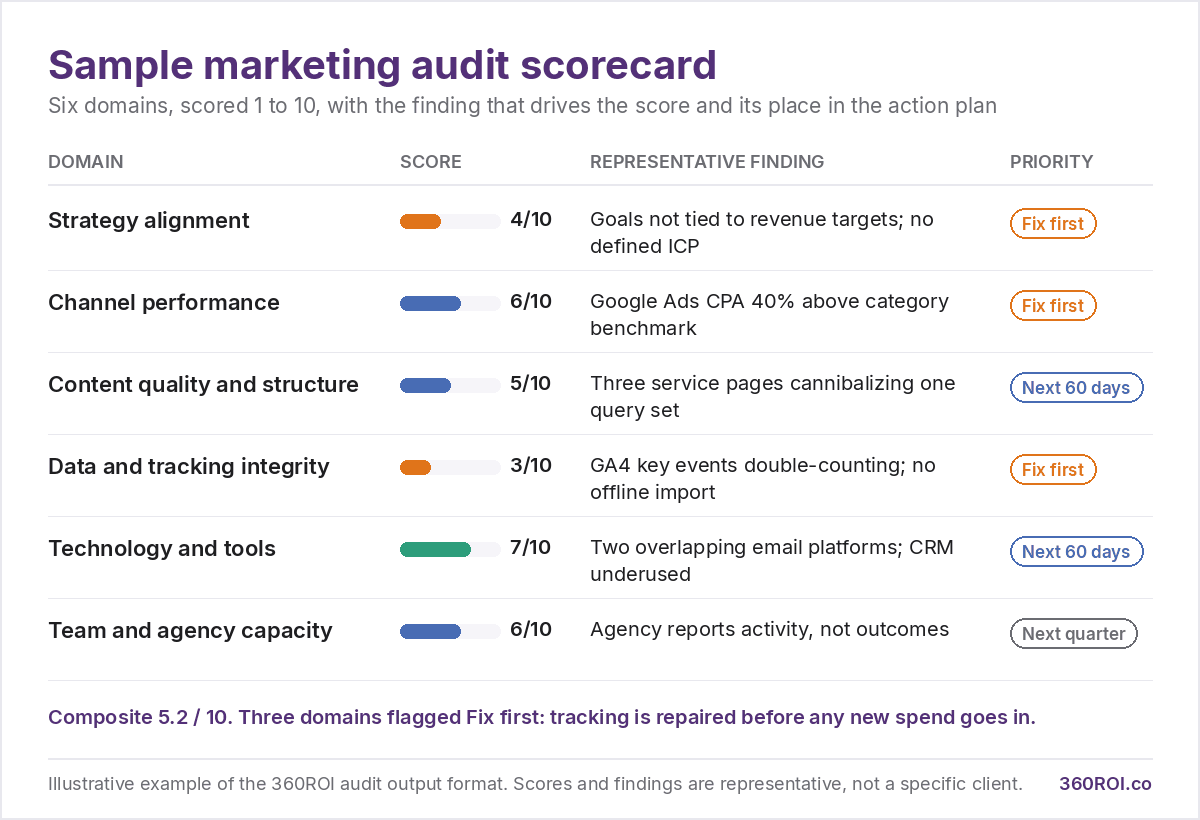
Here is how the six domains come together in the written output. The scorecard below is an illustrative example of the format: each domain scored, the finding that drives the score, and where it sits in the action plan.
How Much Does a Marketing Audit Cost?
A professional marketing audit from an experienced practitioner or boutique consultancy costs between $2,500 and $10,000 for most small and mid-size businesses. The range reflects differences in scope, business complexity, and the depth of analysis across each domain. You will sometimes see this described as a paid marketing audit, which distinguishes it from the free assessments agencies use as sales tools.
At the lower end of the range, an audit typically covers two to three channels and produces a high-level assessment with prioritized recommendations. At the upper end, a complete audit covers all six domains, includes competitive research, data analysis across GA4 and paid platforms, and produces a detailed 90-day action roadmap.
Large agency audits can cost more, sometimes significantly more, but the cost does not always correlate with usefulness. A boutique engagement that produces a clear, actionable output is more valuable than a lengthy slide deck that requires a separate consulting engagement to interpret.
What to budget for: if your marketing spend is $3,000 to $15,000 per month, a $3,500 to $7,500 audit is a reasonable investment. The audit identifies inefficiencies and misdirected spend that often pay for the audit cost within the first 60 days of corrections.
If local visibility is the work being scoped, our breakdown of what local SEO costs gives the channel-level ranges.
Can You Conduct a Marketing Audit Yourself?
Partly. A business owner or in-house marketer can run a useful first pass with the same six domains. List every active channel and its monthly cost. Pull the last 90 days of results per channel from the platform itself, not from an agency summary. Confirm that every conversion that matters is counted once, in GA4 and in the ad platforms. Check whether your most important pages rank for the queries you expect and whether any of your pages compete with each other. Write down every tool you pay for and what it is actually used for.
That pass will surface the obvious waste. Where a self-audit usually falls short is benchmarking and diagnosis. Knowing that a Google Ads campaign converts at 2 percent is only useful if you know whether the category benchmark is 1.5 or 6. Knowing that leads dropped is only useful if you can tell whether tracking broke, the market shifted, or the strategy was wrong. Those judgments are where practitioner experience across many accounts pays for itself, and they are the reason a paid audit is priced the way it is.
Who Should Conduct a Marketing Audit?
The most useful marketing audits come from practitioners who have both strategic and channel-level expertise. A strategist who has never managed a Google Ads campaign cannot meaningfully assess whether your bidding strategy is appropriate. A channel specialist who has not operated at the CMO level will audit tactics without assessing strategy alignment.
At 360ROI, our marketing audit engagement is led by Jaron Mossman. I spent two years managing multimillion-dollar advertising accounts at Google's Manhattan office before building 360ROI's client delivery infrastructure over more than a decade. The audits I run assess every domain with that combination of channel-level and strategic-level context.
What to look for in any audit provider: direct practitioner experience (not analysts or account managers presenting someone else's work), demonstrated familiarity with your revenue stage and business model, and a clear description of what the output format looks like before you engage.
The free assessment offered by large agencies is typically a sales tool, not a strategic diagnostic. That is not necessarily bad, but it is worth understanding what you are getting. More on that distinction below.
What Do You Get at the End of a Marketing Audit?
The deliverable from a professional marketing audit should be a written assessment with two distinct sections: findings and recommendations.
The findings section documents what the audit uncovered in each domain, with specific evidence. Not "your SEO could be stronger" but "your target service pages are not ranking because three of them have duplicate title tags, none have FAQPage schema, and the internal linking structure is not directing authority toward your highest-margin service categories."
The recommendations section prioritizes actions by impact and implementation complexity. A well-structured action plan groups recommendations into three tiers: quick fixes that should happen in the first 30 days, structural improvements that take 60 to 90 days, and strategic investments that require planning and resourcing over the following quarter.
The action plan is the most important output. A findings document with no clear prioritization puts the decision-making burden back on the business owner, which is not what you paid for.
How Is a Paid Marketing Audit Different From a Free Marketing Assessment?
The free marketing audit we offer at 360ROI is an initial assessment. It covers the surface-level signals across your digital presence and gives you a directional read on where the biggest gaps are. It is a quick directional review of your visible signals and produces a summary overview.
The paid marketing audit engagement is a full strategic diagnostic. It involves accessing your actual account data in Google Ads, GA4, and Google Search Console, running competitive research, reviewing your content library, and producing a detailed written output with prioritized recommendations. These are not the same product at different price points. The free assessment is a first-look conversation starter. The paid audit is the diagnostic that gives you the clarity to make confident decisions about your marketing program.
If you are trying to decide whether to hire an agency, restructure your marketing, or invest in a Fractional CMO engagement, the paid audit is the right starting point. If you are not sure whether there is a problem worth solving, the free assessment is the right first step.
When Does a Marketing Audit Lead to a Fractional CMO Engagement?
For many businesses, the marketing audit is not a standalone project. It is the first deliverable in an ongoing Fractional CMO engagement.
A Fractional CMO is responsible for marketing strategy and execution accountability, not just point-in-time recommendations. But the strategy work has to start somewhere, and a thorough audit of the existing program is the most efficient starting point. It surfaces the gaps, establishes the baseline, and produces the roadmap that the ongoing engagement then executes against.
Businesses that get the most value from this sequence: companies with $2M to $15M in revenue that have been running marketing through agencies or internal generalists and have reached the point where inconsistent results and unclear attribution are actively limiting growth. The audit gives them the diagnosis. The FCMO engagement gives them the sustained leadership to act on it. Our guide to what a Fractional CMO engagement costs explains how those retainers are scoped and priced.
If you have been wondering whether your marketing is as effective as it should be at your revenue stage, a structured audit is the most direct way to find out. You will know what is working, what is not, and what to do next. That clarity is worth significantly more than the cost of producing it.
Frequently Asked Questions
Marketing Audits, Answered
What does a marketing audit include?
A complete marketing audit includes six domains: strategy alignment (are your marketing goals tied to business goals?), channel performance (how is each active channel performing relative to benchmarks?), content quality (are your pages built to rank and convert?), data and tracking integrity (is your measurement infrastructure reliable?), technology and tools (are your platforms being used effectively?), and team capacity (do you have the right people in the right roles?). Each domain gets a written assessment with specific findings and prioritized recommendations.
What are the benefits of a marketing audit?
A marketing audit replaces assumptions with a diagnosis. The practical benefits are a clear read on which channels earn their budget, a verified measurement foundation so future decisions rest on accurate numbers, a list of misdirected spend and duplicate tools that can be cut immediately, and a sequenced action plan that says what to fix first. It also settles whether the underlying problem is execution, strategy, or both, which determines whether you need a better agency, a better plan, or different marketing leadership.
How much does a professional marketing audit cost?
For most small and mid-size businesses, a professional marketing audit costs between $2,500 and $10,000 depending on scope and depth. At the lower end, you get a high-level two-to-three channel assessment. At the upper end, you get a complete six-domain audit with competitive research, data analysis, and a detailed 90-day action roadmap. The investment is typically returned in the first two months of corrections to misdirected spend and channel inefficiencies.
How long does a marketing audit take?
A thorough marketing audit from an experienced practitioner takes two to three weeks from kickoff to final deliverable. The timeline reflects the data access setup, the analysis across six domains, competitive research, and the time to write a clear prioritized output rather than a generic presentation. Shorter timelines usually indicate a narrower scope, not a faster process.
Who should perform a marketing audit?
Look for a practitioner with both strategic-level and channel-level expertise. A strategist who has never managed paid media accounts cannot meaningfully audit your bidding strategy. A channel specialist operating without CMO-level context will audit tactics without assessing whether those tactics serve the right goals. The most useful audits come from senior practitioners who have operated across the full marketing stack, not analysts presenting someone else's framework.
What is the difference between a paid marketing audit and a free marketing assessment?
A free marketing assessment is a surface-level review that looks at visible signals across your digital presence. It produces directional guidance. A paid marketing audit involves access to your actual account data, platform-level analysis across GA4, Google Ads, and Search Console, content review, competitive research, and a written deliverable with prioritized recommendations. These serve different purposes: the free assessment identifies whether there is a problem worth investigating, the paid audit diagnoses it precisely.
Is a marketing audit worth the investment?
For businesses spending $3,000 or more per month on marketing without clear attribution to revenue, yes. The audit identifies where that spend is being wasted or underperforming relative to what the budget should be producing. Corrections made in the first 60 days following an audit typically recover the audit cost through improved efficiency. The more significant value is the strategic clarity: knowing what to fix, in what order, and why, before committing to new agency retainers or marketing hires.
When is the right time to get a marketing audit?
The right triggers: before signing a new agency contract (audit your current state first so you can hold the new agency accountable to measurable improvement), before making a significant increase in marketing spend, when results have plateaued despite consistent investment, or when you are considering a Fractional CMO engagement and need a baseline diagnostic before the strategy work begins. The worst time to audit is after you have already committed to a new direction, because the findings may require backing out of decisions already made.
About the author. Jaron Mossman is the founder of 360ROI, a boutique digital marketing consultancy based in Castle Rock, Colorado. He spent two years managing multimillion-dollar advertising accounts at Google's Manhattan office for Fortune 500 travel and hospitality brands before founding 360ROI in 2013. He conducts marketing audits and Fractional CMO engagements for small and mid-size businesses across multiple industries.