

Smart Bidding in Google Ads: What Works and What Doesn't
Smart Bidding works well when your account has the data to support it. Here's exactly when it outperforms manual bidding and when it quietly drains your budget. Published July 29, 2026. Updated September 11, 2026.
Smart Bidding is Google's automated bidding system, which uses machine learning to set bids in real time based on signals like device, location, time of day, and user intent. It works well when an account has sufficient conversion data (roughly 50 or more conversions per month per campaign), accurate conversion tracking, and realistic target inputs. It underperforms on new accounts, low-volume campaigns, and accounts where conversion tracking is incomplete or misconfigured.
Smart Bidding is not magic, and it is not a trap.
It is a tool. Like any tool, its performance depends almost entirely on whether it was given the right inputs to work with.
Google's marketing for Smart Bidding tends toward the optimistic. The platform has a financial interest in advertisers using automation, because automation increases spend velocity and reduces the friction of manual management. That does not make Smart Bidding bad. It does mean the conditions under which it works well are worth understanding before you hand the controls over.
This guide covers what Smart Bidding actually is, when it earns its keep, when it underperforms, and how to set it up in a way that gives it a realistic chance to work.
What Is Smart Bidding in Google Ads?
Smart Bidding is an umbrella term for Google's automated bidding strategies that use machine learning to optimize bids in real time, per auction.
Unlike manual bidding, where you set a maximum CPC (cost per click) for each keyword or ad group, Smart Bidding adjusts your bid for every individual auction based on a range of contextual signals: the user's device, their location, the time of day, their recent search behavior, whether they have visited your site before, and dozens of other factors that Google's system processes in the milliseconds before an ad is shown.
The primary Smart Bidding strategies available in Google Ads are:
Target CPA (cost per acquisition): You set a target cost per conversion. Google's system adjusts bids to try to hit that target across your campaign.
Target ROAS (return on ad spend): You set a target revenue return per dollar spent on ads. Best suited for ecommerce campaigns where transaction values are tracked.
Maximize Conversions: Google uses your full budget to generate as many conversions as possible. No specific CPA target required.
Maximize Conversion Value: Google optimizes for total conversion value rather than conversion count. Useful when different conversions have different revenue values.
What happened to Enhanced CPC: Enhanced CPC, the hybrid strategy that adjusted manual bids up or down by a percentage, was retired for Search and Display campaigns in 2025. New campaigns lost the option in March 2025 and existing campaigns were migrated to Manual CPC by October 2025. If an older guide recommends eCPC as the conservative entry point, that path no longer exists. The conservative starting point today is Maximize Conversions without a target, or a portfolio strategy that pools signal across campaigns.
When Does Smart Bidding Work Well?
Smart Bidding performs best when three conditions are met: sufficient conversion volume, accurate conversion tracking, and realistic target inputs.
Conversion volume. The machine learning system behind Smart Bidding needs data to optimize. Google's official guidance recommends at least 30 to 50 conversions per month per campaign for Target CPA to optimize effectively. In practice, accounts with fewer than 30 conversions per month often see erratic performance, because the system does not have enough signal to find meaningful patterns. Some practitioners set the threshold higher, 50 or more conversions per month, before fully committing to target-based Smart Bidding.
Accurate conversion tracking. This is the most frequently overlooked prerequisite. Smart Bidding optimizes toward whatever you have told Google to count as a conversion. If your conversion tracking is misconfigured (firing on the wrong page, double-counting, or missing mobile completions), you are training the algorithm on incorrect data. Garbage in, garbage out. Before enabling any Smart Bidding strategy, verify that your conversion events are firing correctly and that the conversion values (for revenue-based strategies) are accurate.
Realistic target inputs. A Target CPA or Target ROAS input that does not reflect your actual historical performance creates an impossible optimization target. If your account has historically achieved a $120 CPA and you set a Target CPA of $60, the system will constrict impression share aggressively in pursuit of a target it cannot reach. Set initial targets at or slightly above your actual recent average, then tighten incrementally once the campaign is in a stable learning phase.
When all three conditions are met, Smart Bidding genuinely outperforms manual bidding for most campaigns. The real-time signal processing and auction-level adjustment are capabilities that no human bidding strategy can replicate at scale.
When Does Smart Bidding Underperform?
Smart Bidding consistently underperforms in four specific situations.
New accounts and new campaigns. A campaign with no conversion history is asking Smart Bidding to operate without data. In the learning phase (typically 1 to 2 weeks, longer for low-volume campaigns), performance is often inconsistent. The fix is to build conversion signal rather than wait out a calendar, using cross-campaign history, imported offline conversions, or weighted micro-conversions, and to start target-free on Maximize Conversions only when signal is genuinely absent.
Low-volume campaigns. Campaigns generating fewer than 15 to 20 conversions per month often do not give Smart Bidding enough signal to stabilize. This is a common problem for B2B advertisers, where the product or service generates a small number of high-value leads rather than high volume. In these cases, Target CPA can overly restrict impression share while chasing a statistically unreliable cost target.
Accounts with poor or incomplete conversion tracking. If your conversion tracking is broken or only partially configured, Smart Bidding is optimizing toward incomplete data. This is the scenario most likely to produce unexplained performance drops: the campaign looks like it is running, but it is chasing a faulty signal.
Unrealistic or mismatched target inputs. Setting a Target ROAS that is 3x what the account has historically achieved will not motivate the algorithm to find higher-quality traffic. It will suppress impression share to the point where the campaign barely spends. If targets are not grounded in historical reality, performance will be poor regardless of how sophisticated the underlying system is.
How Do You Set Up Smart Bidding Correctly?
The setup sequence matters more than most guides acknowledge.
Step 1: Verify conversion tracking before anything else. Check Google Ads conversion actions to confirm events are firing. Use Google Tag Assistant or the Google Ads Tag diagnostics tool to verify completeness. If conversion tracking is inaccurate, fix it before changing bidding strategy. Our conversion tracking setup guide covers the full verification pass and the settings that most commonly cause the inaccuracy.
Step 2: Establish conversion signal, not a waiting period. Signal decides whether you can set a target, and time by itself does not create signal. Usable signal can come from cross-campaign history in the account, imported offline conversions from your CRM, a weighted micro-conversion architecture, or portfolio bidding that pools data across campaigns. When any of those exist, you can set a Target CPA or Target ROAS at launch. When conversion signal is genuinely absent or tracking is unreliable, start target-free on Maximize Conversions and add the target once signal exists. Do not fall back to Maximize Clicks, which optimizes for traffic rather than leads.
Step 3: Set realistic initial targets. For Target CPA, start at your actual average CPA from the baseline period or slightly above it. For Target ROAS, start at or just below your actual average. Give the system room to operate. You can tighten targets incrementally once performance is stable.
Step 4: Respect the learning period. After switching bidding strategies, Google enters a learning phase of 1 to 2 weeks. During this period, performance may be inconsistent. Avoid making significant changes to targeting, ad copy, or budget during the learning phase, as each significant change resets it.
Step 5: Decide whether Smart Bidding Exploration should be on. It is the default on Target CPA and Target ROAS campaigns as of June 2026, and it changes how much the system is allowed to spend above your target. The next section explains when to leave it on and when to turn it off. Review cost per conversion weekly for the first month after any target change.
Step 6: Evaluate at 30 days minimum. Smart Bidding performance in the first two weeks is not indicative. Evaluate at 30 days, then 90 days before drawing conclusions about whether the strategy is working.
What Is Smart Bidding Exploration?
Smart Bidding Exploration is a setting on Target CPA and Target ROAS campaigns that lets the system bid on auctions it would otherwise skip, at a cost above your stated target, in exchange for conversions outside your historical pattern. It works through a flexible target: the campaign is allowed to run a defined percentage above the CPA or below the ROAS you set while it explores. Google made it the default on new Target CPA and Target ROAS campaigns in June 2026, so many advertisers have it on without having chosen it.
It helps on a mature campaign with real conversion history and a target that has plateaued. Exploration finds incremental conversions the old bid ceiling was excluding, and the flexible target gives the system room to reach them. It hurts on a campaign that is still establishing signal, where widened bids inflate cost per conversion before the target is trustworthy, and on any account where the CPA ceiling is a hard business constraint rather than a preference.
What to do: check the bidding settings on every Target CPA and Target ROAS campaign to see whether Exploration is on. Leave it on for stable campaigns and review cost per conversion weekly for the first month. Turn it off, or set the target flexibility to its minimum, on campaigns generating fewer than 30 conversions a month or where the target is a hard ceiling.
Which Smart Bidding Strategy Should You Use?
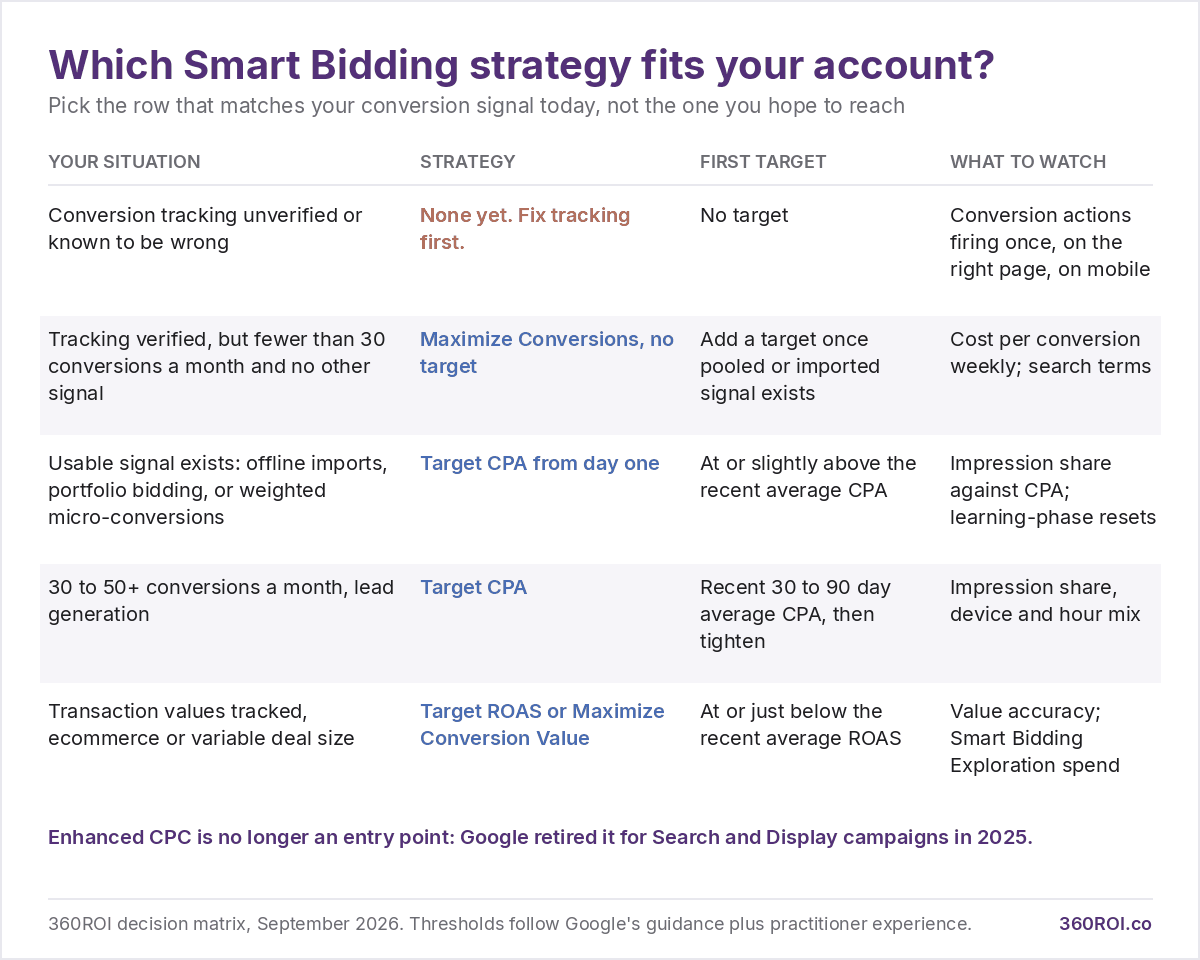
The right strategy follows the conversion signal you have today, not the signal you expect to have after launch. The matrix below is the decision path we use on client accounts.
| Your situation | Strategy | First target | What to watch |
|---|---|---|---|
| Conversion tracking unverified or known to be wrong | None yet. Fix tracking first. | No target | Conversion actions firing once, on the right page, on mobile |
| Tracking verified, fewer than 30 conversions a month, no other signal | Maximize Conversions, no target | Add a target once pooled or imported signal exists | Cost per conversion weekly; search terms |
| Usable signal exists: offline imports, portfolio bidding, or weighted micro-conversions | Target CPA from day one | At or slightly above the recent average CPA | Impression share against CPA; learning-phase resets |
| 30 to 50 or more conversions a month, lead generation | Target CPA | Recent 30 to 90 day average CPA, then tighten | Impression share; device and hour mix |
| Transaction values tracked, ecommerce or variable deal size | Target ROAS or Maximize Conversion Value | At or just below the recent average ROAS | Value accuracy; Smart Bidding Exploration spend |
What Should You Watch After Enabling Smart Bidding?
Smart Bidding does not mean hands-off management. The metrics to watch shift, but the management requirement does not disappear.
Monitor impression share alongside CPA or ROAS. If CPA looks good but impression share has dropped significantly, Smart Bidding may be restricting reach too aggressively to hit the target. This is a signal to loosen the target slightly and accept a higher CPA in exchange for volume.
Watch conversion rate by device and time of day. Smart Bidding adjusts for these signals automatically, but reviewing the data confirms whether the system is allocating spend in ways that match your business reality (for example, if your business only generates qualified leads during business hours, confirming that spend is concentrated there).
Review search terms reports regularly. Smart Bidding does not manage search terms quality. You still need negative keyword discipline to prevent spend on irrelevant queries. Automated bidding and manual search term management run in parallel. See our full guide on Google Ads Quality Score for more on the signals that affect ad relevance.
For businesses evaluating whether their current Google Ads campaigns are set up to perform, a free marketing audit covers bidding strategy configuration alongside budget allocation and tracking quality.
Frequently Asked Questions
Smart Bidding, Answered
What is Smart Bidding in Google Ads?
Smart Bidding is Google's automated bidding system that uses machine learning to set bids in real time, per auction. Unlike manual bidding where you set a fixed maximum cost per click, Smart Bidding adjusts your bid for every individual ad auction based on signals including device, location, time of day, and user behavior history. The primary strategies are Target CPA, Target ROAS, Maximize Conversions, and Maximize Conversion Value.
Does Smart Bidding actually work?
Yes, when the account conditions support it. Smart Bidding performs best when a campaign has 30 to 50 or more conversions per month, accurate conversion tracking, and target CPA or ROAS inputs that reflect historical account performance. It underperforms on new accounts, low-volume campaigns, and accounts with misconfigured or incomplete conversion tracking. The strategy is a tool, not a guarantee.
How many conversions do I need before using Smart Bidding?
Google's guidance recommends at least 30 conversions per month per campaign for Target CPA to optimize effectively. Many practitioners use 50 conversions per month as the practical threshold before committing to target-based strategies. Below this volume, the machine learning system has insufficient data to find reliable patterns, and performance tends to be erratic. For campaigns below this threshold, the fix is to build usable conversion signal rather than wait out a calendar. Import offline conversions from your CRM, add weighted micro-conversions, or pool data across campaigns with portfolio bidding, then set a target once real signal exists. Reverting to Maximize Clicks is not the answer, because it optimizes for traffic rather than for leads.
What is the Smart Bidding learning period?
When you change bidding strategies (or make significant changes to an active Smart Bidding campaign), Google enters a learning period of approximately 7 to 14 days. During this period, the system is gathering data and performance may be inconsistent. Avoid making additional significant changes to targeting, budget, or ad copy during the learning period, as each significant change can restart the clock.
What is Smart Bidding Exploration?
Smart Bidding Exploration is a setting on Target CPA and Target ROAS campaigns that lets Google bid on auctions it would otherwise skip, at a cost above your stated target, to find conversions outside your historical pattern. It uses a flexible target that allows the campaign to run a defined percentage past the target you set. It became the default on new Target CPA and Target ROAS campaigns in June 2026. Leave it on for mature campaigns with a plateaued target and review cost per conversion weekly. Turn it off, or minimize the target flexibility, on campaigns under 30 conversions a month or where the target is a hard ceiling.
How do I set a good Target CPA for Smart Bidding?
Set your initial Target CPA at or slightly above your actual average CPA from a recent 30 to 90 day period. If your historical average CPA is $120, start with a target between $120 and $140. Setting a target dramatically below your historical average (for example, $60 when your account averages $120) will cause Smart Bidding to restrict impression share aggressively in pursuit of a target it cannot reach. Tighten the target incrementally once the campaign has 30 days of stable performance data.
What is the difference between Smart Bidding and Performance Max?
Smart Bidding refers to the automated bidding strategies (Target CPA, Target ROAS, Maximize Conversions, etc.) that apply within standard campaign types: Search, Display, Shopping. Performance Max is a separate, fully automated campaign type that uses Smart Bidding by default and extends across all Google Ads inventory simultaneously, including Search, Display, YouTube, Discover, Gmail, and Maps. Smart Bidding is a bidding mechanism. Performance Max is a campaign type that uses Smart Bidding as its foundation.
Should I use Smart Bidding for my Google Ads campaigns?
For campaigns with sufficient conversion volume and accurate tracking, Smart Bidding is generally the right choice. Google's machine learning processes auction-level signals that no manual bidding approach can replicate at scale. For new campaigns or accounts with low conversion volume, the question is whether usable conversion signal exists, not how many weeks have passed. Build that signal first through offline conversion imports, weighted micro-conversions, or pooled portfolio data, then set a target. Falling back to Maximize Clicks is discouraged, because it optimizes for traffic volume rather than for qualified leads.
About the author. Jaron Mossman is the founder of 360ROI, a boutique digital marketing consultancy based in Castle Rock, Colorado. He spent two years managing multimillion-dollar advertising accounts at Google's Manhattan office for Fortune 500 travel and hospitality brands before founding 360ROI in 2013. He manages Google Ads campaigns across a portfolio of SMB clients with a focus on conversion-driven account structures.